
Our Services
Home / Our Services / Carbon Accounting & CBAM Training
Carbon Accounting & CBAM Training
An intermediate virtual training that equips professionals to measure, manage and report carbon emissions, and to prepare their organisation for the EU’s Carbon Border Adjustment Mechanism (CBAM).

Background
As nations work to reduce greenhouse gas emissions, policies like the European Union’s Carbon Border Adjustment Mechanism (CBAM) and India’s Carbon Credit Trading Scheme (CCTS) are reshaping how businesses measure and manage their carbon footprint. Central to these efforts is the accurate quantification, monitoring, reporting and verification of greenhouse gas (GHG) and carbon emissions.
About the Training
Join the Indo-German Chamber of Commerce for a virtual intermediate training on Carbon Accounting and CBAM. This 3-module training equips professionals to understand and navigate carbon accounting for their organisation and product-specific accounting in preparation for the Carbon Border Adjustment Mechanism. The course combines German training and pedagogy standards with a curriculum adapted to the Indian business environment.
Participants gain an understanding of the fundamentals of carbon accounting in line with internationally recognised methodologies such as the GHG Protocol, and an in-depth understanding of CBAM, including its applicability and requirements for exporters to Europe.
Course Structure
Three live virtual modules of 3 hours each, plus a 3-hour self-learning component.
➔ Module 1 – Fundamentals of Carbon Accounting: Regulations and drivers of industrial decarbonisation; key concepts and terminology; carbon accounting methodologies, Scope 1, 2 and 3, and data sources; carbon accounting in practice (step-by-step); case study-driven exercise on organisational carbon footprinting.
➔ Module 2 – Product-Level Carbon Footprint: Key considerations, concepts and relevance to CBAM; conducting a product footprint study (scope and boundaries, data collection, step-by-step); organisational set-up for footprinting; case study-driven exercise on product-level footprinting.
➔ Module 3 – Carbon Accounting & CBAM: Understanding the EU’s CBAM and its background; scope and applicability; implications for Indian exporters; CBAM methodologies and requirements; verification and reporting frameworks; case study-driven exercise on calculating product emissions for CBAM.
➔ Self-Learning Component: Handout materials with self-study resources and reference links for further learning.
Benefits
✓ Deepen your knowledge of carbon accounting methodologies in line with GHG Protocol standards.
✓ Align your organisation’s compliance with the regulatory impacts of the Carbon Border Adjustment Mechanism (CBAM).
✓ Develop practical understanding and skills for quantifying and reporting GHG emissions.
✓ Enhance your ability to implement effective carbon management strategies within your organisation.
Who Should Apply
The training is open to professionals working in manufacturing sectors and industries with production-oriented supply chains, including Sustainability and ESG Professionals, C-Suite Executives, Heads of Compliance and Senior Compliance Officers, Heads of Supply Chain, and Heads of Procurement and Purchasing.
We offer customised (on-demand) workshops and regular batch trainings.
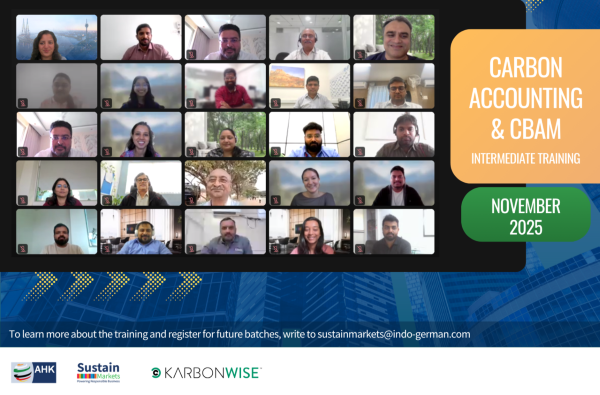
Next Batch – Q4 2026
Batch Fees
➞ IGCC Members: INR 29,900 (+18% GST)
➞ Non-Members: INR 34,900 (+18% GST)
Participants receive an IGCC Certificate of Participation on successfully completing the training.
For queries, please write to: sustainmarkets@indo-german.com


Blogs

As global climate regulations continue to evolve, Indian businesses are preparing for a new era of compliance, transparency, and competitiveness. With the European Union’s Carbon Border Adjustment Mechanism (CBAM) moving closer to its fully operational phase at the beginning of 2026, and India’s Carbon Credit Trading Scheme expected to be in effect…

As the global economy pivots towards decarbonisation, Indian exporters are facing mounting pressure to align with international climate standards. With the European Union’s Carbon Border Adjustment Mechanism (CBAM) on the horizon, preparedness is no longer optional, it is a strategic imperative…

In October 2023, the EU starts mandating importing European companies to report and at a later stage (2026) pay for the actual value of embedded emissions of imported goods, especially from high-emitting sectors…
Get In Touch With Us

Address: Indo-German Chamber of Commerce,
Maker Tower ‘E’ Wing, First Floor,
Cuffe Parade, Mumbai – 400005,
Maharashtra, India
Call Us: +91-20-41047-100
Email: sustainmarkets@indo-german.com


Leave us a Message
Quick Links
2026 Copyright © Indo-German Chamber of Commerce.
All Rights Reserved.